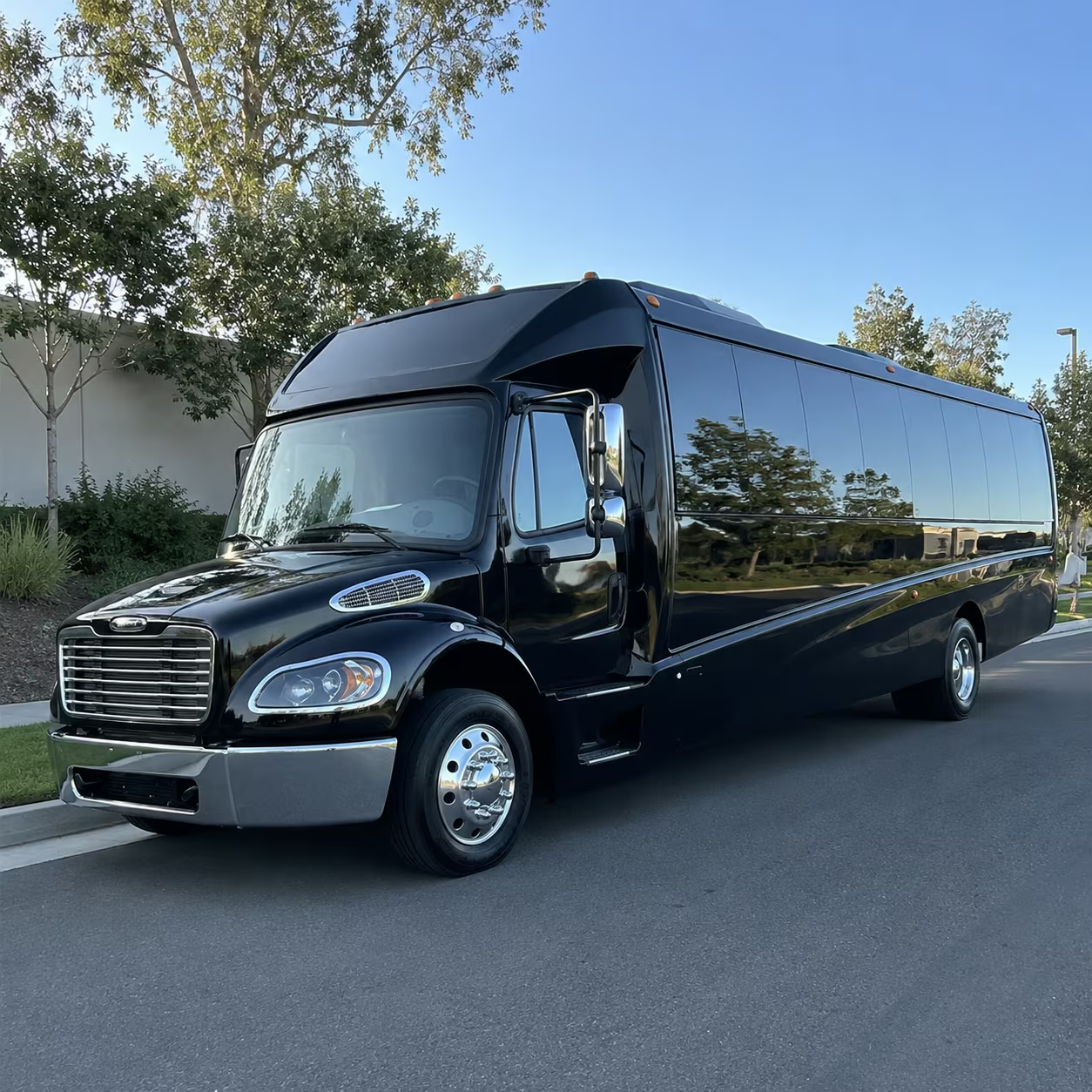
There's a moment every group coordinator dreads: your flight lands at Terminal D, half the group is at Terminal E, rideshare prices have already surged, and nobody can agree on where to converge. DFW is the third-busiest airport in the world — 87.8 million passengers moved through its five terminals in 2024 — and it earns that ranking with a scale that genuinely surprises first-timers: a 26-square-mile footprint straddling Grapevine, Irving, Euless, and Coppell, a 4.81-mile internal Skylink rail loop, and five terminals that don't connect at street level the way a group needs them to. A Dallas charter bus or party bus rental solves all of it cleanly.
One vehicle collects your group at a single curbside, drops everyone at the right terminal, and stages nearby through any delay — no splitting the group across three rideshare apps, no frantic "where are you?" texts in the arrivals hall. Below is the complete operational picture: where the bus drops, where it waits, what DFW's ongoing construction means for your timeline, and which vehicle fits your headcount and luggage load.
Why Rent a Charter Bus or Party Bus to DFW Airport?
With 87.8 million passengers a year — a 7.4% jump from 2023 — DFW pushes more traffic than any other airport in Texas, and International Parkway shows it. The airport's main north-south road is currently mid-project on a major bridge-replacement program, with DFW's own guidance recommending travelers add 30 to 45 minutes to their normal drive time and arrive at least two hours early for domestic departures, three for international. Groups navigating that in separate cars or a string of rideshares are doing it at the worst possible moment: peak arrival traffic, five separate curbside pickup zones marked with blue app signs, and an algorithm that's pricing in everyone else's inconvenience at the same time.
One bus changes the equation. Drop-off is curbside at any terminal's lower level — your group unloads together, no one hunts for a rideshare that's circling, no one's checked bag gets left behind in a different car. On the pickup end, the bus stages at a remote holding area until your group coordinator places the call, then pulls to the lower-level curb in a single move.
Coordinating 30 people into eight separate cars during a post-international-arrival rush is the alternative. The Dallas airport transportation page covers both DFW and Love Field — this guide goes deeper on DFW specifically, with verified terminal-by-terminal logistics.
Charter Bus & Party Bus Drop-Off and Pickup at DFW Airport
Charter buses drop off and pick up at the lower-level (Arrivals) curbside of each terminal, per DFW's official ground transportation page. After exiting baggage claim, follow signs marked "Ground Transportation" to reach the lower-level curb. Wide lanes designated for oversized vehicles — marked with yellow signs at each entry plaza — let full-size coaches move through without squeezing into standard passenger-car lanes.
One operational rule governs every pickup at DFW: the bus cannot wait at the curbside. DFW's traffic management keeps the Arrivals Level curb in constant motion, which means the bus stages in a remote commercial vehicle holding area until the group coordinator calls. Call only when every member of your group has their luggage and is assembled at the agreed curb location — a premature call can mean the bus circles for an additional 20 minutes before it can return.
Designate one coordinator before the flight, set a specific terminal and curbside door as the meeting point, and the pickup runs on schedule.
Terminal C and the Skylink Workaround
Terminal C's lower level is one of the more congested pickup points at DFW right now. Construction under the DFW Forward capital program relocated ground transportation stops and tightened curbside access at Terminal C. If your group arrives at Terminal C and the lower level is backed up, the cleanest move is the Skylink — DFW's free, airside light rail that connects all five terminals every two minutes, 24 hours a day — to relocate your group to Terminal D's lower level, where curbside access runs more smoothly and there's more room for large vehicles. Communicate this plan before deplaning so the whole group heads the same direction.
Your coordinator calls the bus from Terminal D's lower-level curb instead of Terminal C's — the bus adapts.
The ready-call rule at DFW: Never call the bus until every member of your group has luggage in hand and is standing at the agreed curbside point. At an airport handling 87.8 million passengers a year, DFW's lower-level traffic enforcement moves fast — a bus sitting without active loading gets directed to circulate immediately, adding up to 20 minutes before it can return to the curb.
DFW Airport Terminal Guide for Groups
DFW's five terminals form two arcs on either side of International Parkway — A and B on the north side, C and D facing them, and Terminal E tucked south of Terminal C with no walkway connecting it to the others. Which terminal matters for your group because it determines your bus drop-off location, your rail option if part of the party is using transit, and how DFW's current construction affects your approach route.
| Terminal | Primary airlines | Rail access | Construction & access notes |
|---|---|---|---|
| A | American Airlines mainline (26 gates) | DART Orange Line — Entry A-10, lower-level curb | New right-hand exit from International Parkway open; follow updated signage |
| B | American Eagle regional | DART Silver Line (Plano→Addison→Carrollton); TEXRail (Fort Worth, 45 min, ~$2.50); TRE Link shuttle from CentrePort/DFW Airport Station | New bridge completed; accessible via southbound International Parkway |
| C | American Airlines domestic mainline | None direct — use Terminal Link or Skylink from other terminals | New right-hand exit bridge completed; lower-level curbside remains tighter than other terminals — consider Skylink to Terminal D for charter bus pickup |
| D | International: Air France, British Airways, Emirates, Lufthansa, Qantas, Japan Airlines, Korean Air, Aeroméxico, Avianca | Terminal Link pre-security; Skylink post-security from other terminals | Wider lower level; good alternative pickup point for Terminal C arrivals |
| E | Air Canada, Alaska Airlines, Delta, Frontier, JetBlue, United | None direct — use Terminal Link before security | No active construction impact; lower-level curbside relatively clear |
For international arrivals at Terminal D, customs and immigration processing adds 30 to 90 minutes after landing before the group reaches the lower-level curbside — build that buffer into the bus pickup call, not your GPS arrival estimate. For groups scattered across multiple terminals on connecting flights, a 15–35 passenger minibus can run a terminal circuit — picking up at Terminal E, then Terminal C or D in sequence — instead of requiring everyone to converge on one spot before loading. That circuit approach is worth discussing when you request your quote, because it saves the group the coordination time of waiting on a single meeting point.
DFW Airport Construction: What Groups Need to Know in 2025–2026
DFW is in the middle of the most ambitious capital program in its history — a nearly $9 billion initiative called DFW Forward — and the piece that affected every vehicle approaching the terminals was the International Parkway Modernization Project. The work converted terminal access from left-hand exits off International Parkway to new right-hand exit bridges, phased in sequentially across Terminals B, A, and C. New right-hand exit bridges for all three terminals — A, B, and C — are now complete and open, per DFW's own construction updates.
The practical impact: DFW's construction page recommends adding 30 to 45 minutes to normal travel time, arriving two hours early for domestic departures and three hours early for international, as periodic weekend lane reductions and exit adjustments continue on a rolling basis. GPS apps haven't universally updated to the new right-hand exit positions, so groups relying on old navigation routes may miss the correct terminal entry. Follow on-site signage over GPS guidance until mapping providers catch up.
The Terminal C lower level also saw Ground Transportation stop relocations as part of the project — the Terminal Link shuttle stop at Terminal C was reduced to a single stop near Gate C17, and curbside access shifted. If your group departs from or arrives at Terminal C, knowing the Skylink-to-Terminal-D workaround in advance saves 20 to 30 minutes of curbside confusion. Review the official DFW directions page before departure for current terminal access signage.
Getting Groups to DFW: Every Option Compared
DFW has more ground transportation options than almost any airport in the country — four rail systems, rideshare pickup zones at all five terminals, a network of shared shuttles, and free waiting lots at both ends of the airport. Here's an honest look at how each option handles a group, scored on what actually matters to a planner moving 20 or more people.
| Option | Cost shape | Group stays together? | Terminal reach | Best for |
|---|---|---|---|---|
| Private charter bus or party bus | One flat rate, split across the group | Yes — one vehicle, one curbside drop | Lower-level Arrivals curb at all 5 terminals; yellow-marked wide lanes | 15–56 passengers with luggage; multi-hotel pickup circuits; arrival coordination |
| DART Orange Line | ~$2.50–$5 per person | Only if everyone boards together; no luggage racks | Terminal A (Entry A-10) only | Solo travelers or small groups flying American Airlines at Terminal A |
| TEXRail (Trinity Metro) | ~$2.50 single / $5 day pass | Only if on the same train | Terminal B only; 45-minute ride from downtown Fort Worth | Individuals or small groups coming from the Fort Worth side |
| TRE + TRE Link Shuttle | Included with TRE ticket | Shuttle, not guaranteed group seating | Terminal B (check current terminal access before travel) | Individuals connecting from TRE rail from Dallas or Fort Worth |
| Rideshare (Uber / Lyft) | Per car, each way; surge during peak arrivals | No — multiple cars, staggered ETAs | Blue Ride App signs at lower level of each terminal | 1–4 people per car |
| Rental car fleet | Daily rate + fuel per car; shuttle to consolidated Rental Car Center first | No — separate cars, separate parking | Requires shuttle to Rental Car Center before leaving the airport | Solo travelers needing independent vehicle access for the full trip |
The rail options are genuinely compelling for individual travelers. TEXRail's 45-minute run from downtown Fort Worth for $2.50 is difficult to argue with on a budget, and DART's Orange Line to Terminal A is a direct shot from downtown Dallas without a transfer. But rail has a hard ceiling for groups: no guaranteed seats together, no space for 20 pieces of checked luggage, and no flexibility when a flight runs 90 minutes late.
A Dallas charter bus picks up at a hotel, holds for a delayed arrival, and handles the bags in one undercarriage load.
The cell phone lots are the practical free-waiting option worth knowing: DFW maintains a North Cell Phone Lot (53 spaces, before the North toll plaza) and a South Cell Phone Lot (approximately 60 spaces, near Rental Car Drive and Southgate Avenue) with complimentary parking up to two hours, per the official DFW cell phone lot page. A single car picking up two people — that works fine. A 40-passenger charter bus does not park in a cell phone lot.
The bus stages in a designated commercial vehicle holding area and moves to the terminal curbside when you call. That's the operational reality at an airport this size.
What Bus Fits Your DFW Airport Group?
DFW airport runs fall into a few common patterns: a corporate team shuttling from a Las Colinas hotel block to Terminal E, a large international arrival moving from Terminal D's baggage claim to a conference hotel in Uptown Dallas, or a departure circuit picking up guests from multiple North Texas hotels before dropping at the terminal. Each calls for a different vehicle from the full lineup — here's how the options stack up against real airport logistics.
| Vehicle | Capacity | Luggage handling | Best DFW airport use | Key features |
|---|---|---|---|---|
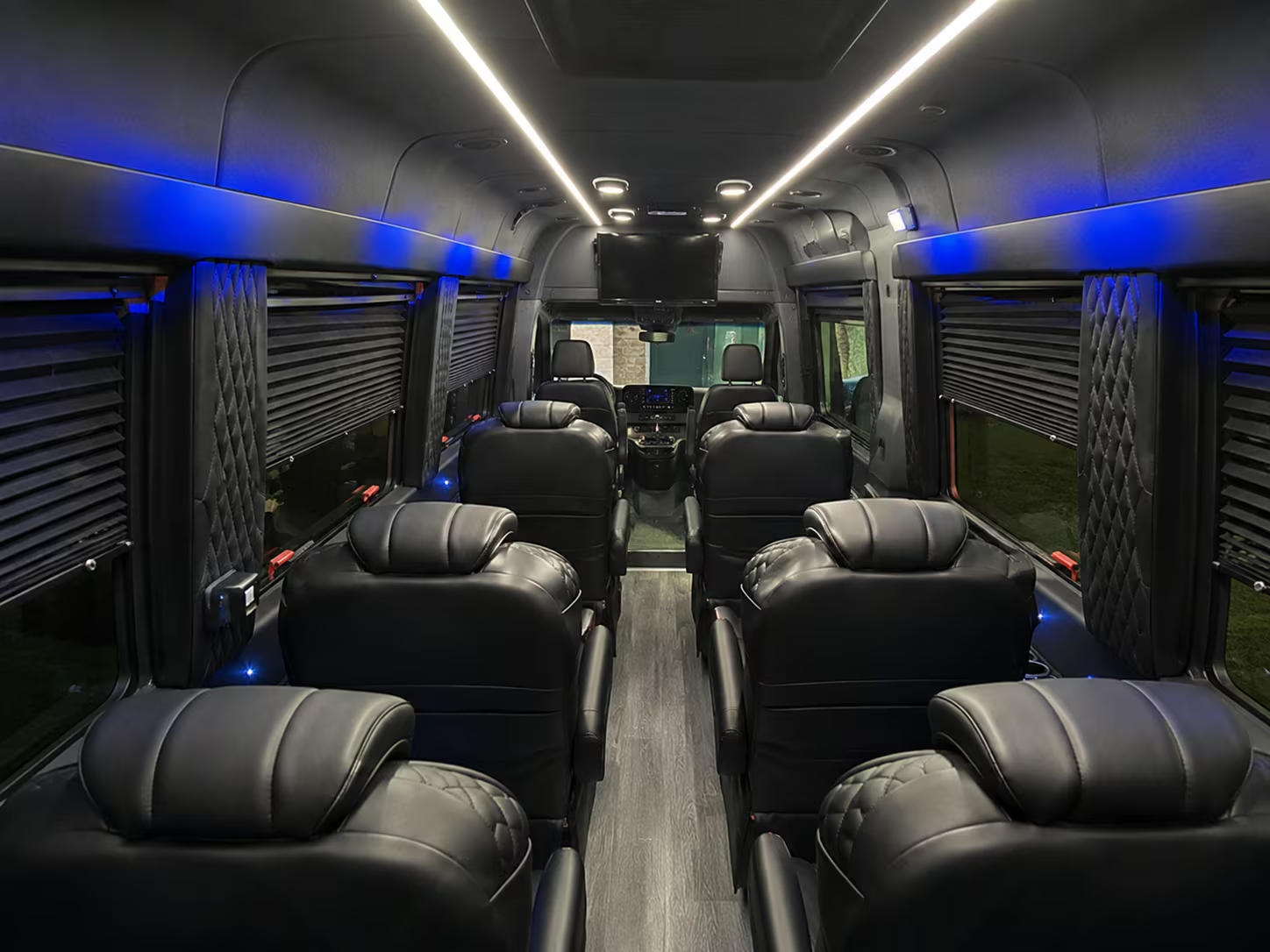
| Sprinter Van | Up to ~14 | Modest — carry-ons and a few bags | Executive team pickup at Terminal D; VIP arrivals on tight schedule | Premium leather, USB charging at every seat, tinted privacy windows |
| 14-Passenger Sprinter Limo | Up to 14 | Modest | Small group departures with a polished presentation on the upper curb | LED interior lighting, premium cabin, privacy glass |
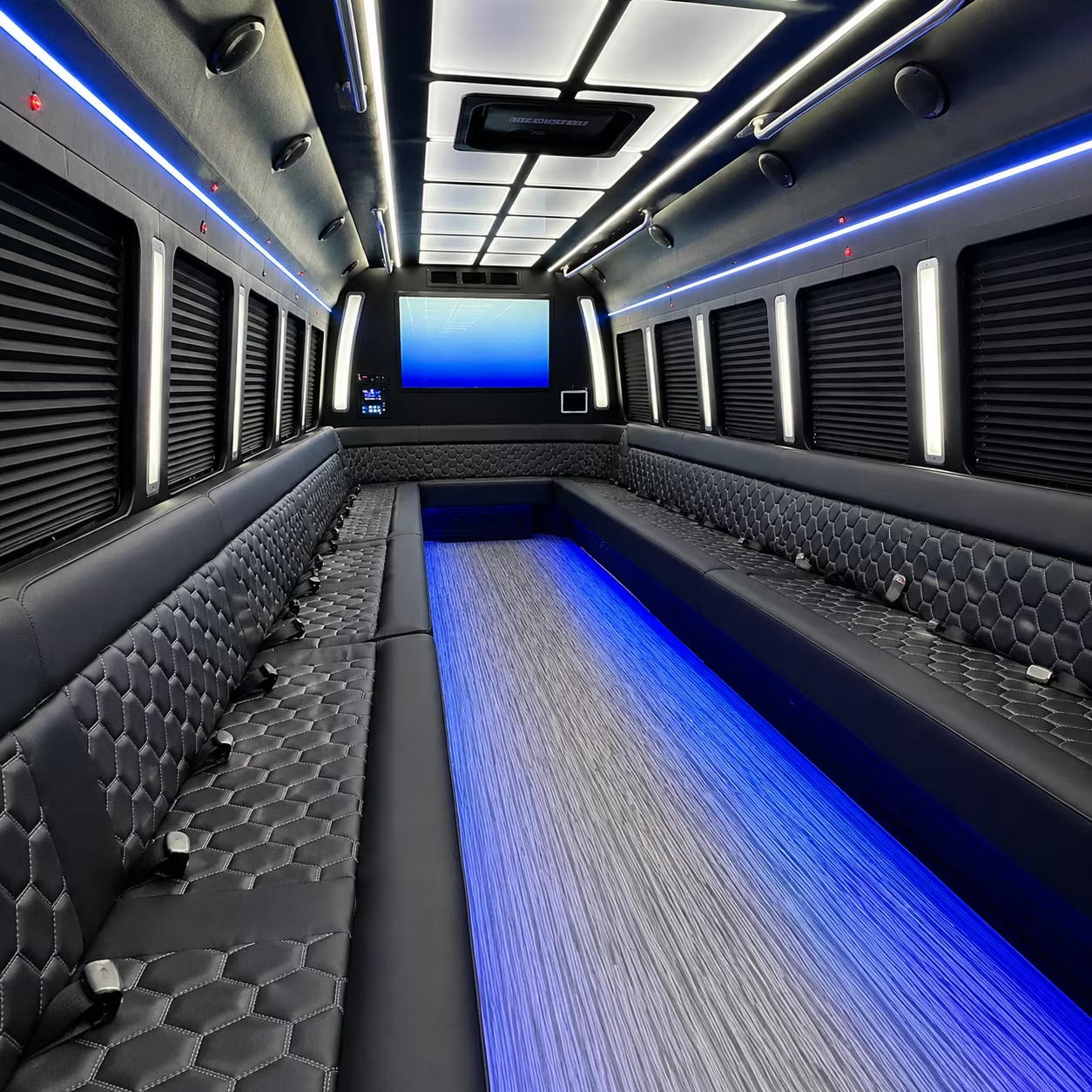
| 15–35 Passenger Minibus | 15–35 | Overhead plus some underfloor | Mid-size team transfers; terminal circuit pickups; hotel-to-terminal runs with carry-ons | Powerful A/C, plush reclining seats; size makes it easier through Terminal C's tighter lower-level curbside |
| 40–56 Passenger Charter Bus | Up to 56 | Excellent — deep undercarriage bays hold all checked luggage | Large group arrivals at Terminal D or E with full checked bags; conference team transfers | Reclining seats, climate control, overhead storage, WiFi, power outlets, onboard restroom, undercarriage bays |
The single biggest variable at DFW is luggage. A 35-person group returning from a week-long conference arrives at Terminal E with 35 checked bags plus carry-ons — a minibus without undercarriage storage cannot physically absorb that load, and splitting luggage across a trailer or cargo van adds complexity to an already-tight curbside window. A full-size 40–56 passenger charter bus takes all of it in the undercarriage bays in one load, then pulls to the curbside for a clean single pickup.
For groups of 15–35 traveling lighter — a corporate day trip, a team moving in carry-ons — the minibus navigates Terminal C and D's lower-level approaches more easily than a full-size coach. Match the vehicle to your actual bag count, not just your headcount.
Dallas Charter Bus and Party Bus Rental Prices for DFW Airport Runs
Airport transfers at DFW price differently from event runs. A clean one-way drop from a hotel block to the terminal is a shorter commitment than a circuit pickup that covers three hotels, or a charter that stages through a delayed international arrival. To give you a planning range from the network serving Dallas: a minibus typically runs $200–$250 per hour on weekdays and $200–$275 per hour on weekends, with per-day rates in the range of $1,100–$2,150.
A full-size charter bus runs $200–$350 per hour on weekdays with per-day rates between $1,350 and $2,850. Sprinter vans run $200–$275 weekday / $225–$375 weekend per hour.
Your specific quote — based on your headcount, pickup address, terminal, date, and how many hours the vehicle is reserved — comes through the quote form or a call to 903-421-9126 in under a minute. Those ranges are example pricing to help you plan; the actual quote accounts for your route. See the Dallas party bus prices page for more context on what shapes the final rate.
For a cost comparison that puts a bus in perspective: DFW's terminal garages run $32 per day at the drive-up rate, while the Remote North and South lots run $14 per day with complimentary shuttle service to every terminal. A 30-person group arriving in 10 cars for a five-day trip pays $700–$1,600 in Remote parking alone — not counting fuel, the shuttle wait, or the fact that somebody in each car has to stay sober for the drive home from the lot. One charter bus collapses that to a single flat rate and keeps the group together from door to curb.
Getting to DFW: Approach Routes, Drive Times, and What Actually Backs Groups Up
DFW sits between Dallas and Fort Worth — geographically centered in the Metroplex, but not at the center of either city's road network. The airport has two main entry points: the South Entrance via State Highway 183 from Irving, Dallas, or Arlington, and the North Entrance via State Highway 114 or Interstate 635 from Grapevine, Las Colinas, or any point north of the airport. Once inside either plaza, International Parkway runs the full length of the airport north to south, with all five terminals, parking facilities, and on-site hotels connecting off it.
The official DFW directions page has the current approach guidance — especially useful now, with new right-hand exits at Terminals A, B, and C replacing the older left-turn entries that some GPS apps still show.
Off-peak drive times from common Metroplex pickup points — and these balloon significantly during rush hours (7–9 AM and 4–7 PM on weekdays):
| From… | Approx. distance | Off-peak drive time |
|---|---|---|
| Downtown Dallas | ~20 miles | ~23 minutes |
| Downtown Fort Worth | ~24 miles | ~26 minutes |
| Arlington (via TX-360) | ~12–16 miles | ~23 minutes |
| Plano (via I-635 E) | ~28 miles | ~35 minutes |
| Las Colinas / Irving (via SH-114) | ~8 miles | ~10–15 minutes |
| Grapevine | ~6 miles | ~10 minutes |
Those off-peak numbers are the best-case scenario, and they're built for a single car moving with traffic. The problem for groups is the coordination layer on top: one car catches the light on I-35E, another misses it, and by the time both reach the terminal, one subgroup is already through bag drop while the other is still circling the Arrivals level looking for parking. A bus running a hotel circuit — picking up at two or three hotels in a set sequence — eliminates that entirely.
The group arrives at the terminal curbside together, not in staggered waves ten minutes apart.
What Every Group Coordinator Should Know Before Arriving at DFW
Know your terminal before you land. DFW's five terminals do not all connect at street level — Terminal E has no walkway linking it to the others, and Terminal Link (the pre-security bus) runs only from 5 AM to 1 AM. If your group's checked bags are at Terminal E and one team member is connecting through Terminal D, those are two separate curbside pickups unless you coordinate a Skylink move inside security.
Sort terminal assignments before the flight, not after baggage claim.
International arrivals at Terminal D take longer than the flight schedule suggests. Customs and immigration processing can add 30 to 90 minutes after landing, depending on the volume of international arrivals sharing the floor. If you're picking up an international group at Terminal D, call the bus only after every member has cleared customs, collected luggage, and exited to the outer curb — not based on the posted arrival time.
The bus stages until you call, so the only cost of that delay is time, not a recircle.
Terminal C's lower level curbside layout changed as a result of recent construction. Construction relocated Terminal Link stops and shifted curbside ground transportation access at Terminal C. If conditions look backed up when you arrive, the Skylink to Terminal D's lower level is the cleanest workaround — communicate that plan to your coordinator before the flight touches down, so the whole group moves in the same direction.
Check the official construction page before your trip date. The International Parkway Modernization Project's new right-hand exit bridges are complete, but periodic weekend lane reductions and exit adjustments are still being announced on a rolling basis. Review DFW's construction updates in the week before your trip — especially around holiday weekends, when active work sometimes schedules into lower-traffic windows.
First-timers following older GPS routes to a terminal that recently switched to a right-hand exit may find the old route leading to a closed lane.
DFW's address is between Grapevine and Irving, not in either city. The airport's official address is 2400 Aviation Dr, DFW Airport, TX 75261, spanning portions of Grapevine, Irving, Euless, and Coppell. Groups coming from Fort Worth should use the North Entrance off SH-114; groups from Dallas or Irving generally use the South Entrance via SH-183.
Getting that right keeps the bus from entering on the wrong end of International Parkway and adding a full lap to reach the correct terminal.
Rail Options to DFW: When They Work and When They Don't for Groups
Four separate rail systems reach DFW, and they're worth knowing because some groups mix rail with a charter bus pickup — individuals using the train, larger luggage-heavy subgroups using the bus. Here's how each one connects to the terminals:
DART Orange Line → Terminal A. The Orange Line runs from Plano through downtown Dallas and Irving, terminating at the DFW Airport Station at Terminal A, Lower Level Curb, Entry A-10. Service runs seven days a week.
This is the primary transit option for groups flying American Airlines mainline out of Terminal A — though without luggage racks and no reserved group seating, it's best suited for individuals and small groups traveling light.
DART Silver Line → Terminal B. This newer service connects Plano, Richardson, Addison, Carrollton, and Coppell to Terminal B via a northern route that bypasses downtown Dallas — faster for groups based in the northern suburbs. Check DFW's public transit page for current Silver Line schedules before your departure date.
TEXRail (Trinity Metro) → Terminal B. TEXRail makes a 27-mile run from downtown Fort Worth through Grapevine and North Richland Hills to Terminal B, with trains every 30 minutes during weekday peak hours and every 60 minutes on evenings and weekends. The ride runs roughly 45 minutes from Fort Worth Central Station at a fare of about $2.50 per person — a genuine value for individuals.
For a 30-person group with checked luggage, the math changes: 30 people needing seats on the same train, with no space for a pile of bags.
TRE Link Shuttle → Terminal B. The Trinity Railway Express connects Dallas and Fort Worth to CentrePort/DFW Airport Station, where the TRE Link shuttle carries passengers to DFW terminals. The shuttle runs every 20 minutes during weekday peak hours and every 40 minutes during off-peak times.
No Sunday service. See Trinity Metro's TRE Link page for current terminal access information before your travel date — the landing point has shifted during construction periods and may update again as the International Parkway Project completes.
Frequently Asked Questions
Where exactly does a charter bus drop off at DFW airport?
Charter buses drop off and pick up at the lower-level (Arrivals) curbside at each of DFW's five terminals — A through E. Wide lanes marked with yellow signs at each terminal's entry plaza accommodate oversized vehicles. Follow "Ground Transportation" signage from baggage claim. One exception: Terminal C's lower level curbside was reconfigured during recent construction, so groups arriving at Terminal C may still find it faster to use the Skylink to move to Terminal D's lower level for pickup, where curbside access is less congested.
Can the charter bus wait for my group at DFW?
Not at the curbside — DFW's traffic management keeps the Arrivals curb in continuous motion, and buses are directed to stage in a remote commercial vehicle holding area rather than park at the curb. The process is: designate one coordinator, wait until every group member has luggage in hand and is at the agreed terminal curb location, then call once. A premature call means the bus circles and returns — roughly 20 additional minutes.
The bus is booked as a block of hours, so it does not leave the airport; it simply stages until you're ready.
Which terminal will my group use at DFW?
It depends on the airline. American Airlines mainline typically uses Terminals A and C; American Eagle regional uses Terminal B; international carriers including British Airways, Emirates, Lufthansa, Air France, and Qantas use Terminal D; and Alaska Airlines, Delta, United, JetBlue, Frontier, and Air Canada use Terminal E. Confirm your specific terminal from your boarding pass before departure — it determines your bus drop-off location and which International Parkway exit applies to your approach.
How does DFW's construction affect charter bus pickups?
International Parkway's new right-hand exits to Terminals A, B, and C are now open, but some GPS routing still shows the old left-turn exits — follow on-site signage over navigation apps until mapping providers catch up. Add 30 to 45 minutes to normal drive time as a precaution. Terminal C's lower level curbside ground transportation stops were relocated during construction.
Check DFW's construction page before your trip for current closure advisories and lane reduction schedules.
How much does it cost to park at DFW if my group drives?
Terminal garage parking runs $32 per day at the drive-up rate, per DFW's terminal parking page. Remote North and South lots run $14 per day with complimentary shuttle service to every terminal, per the Remote parking page. Prebooking online saves up to 50% on both.
For a 20-person group driving in seven cars over a four-day trip, Remote parking alone runs $392 — plus fuel per car and the shuttle wait. One charter bus transfers that to a single flat rate with no shuttle leg.
What are the free waiting areas at DFW while I wait for my group to land?
DFW has two free cell phone lots, per the official cell phone lot page: the North Cell Phone Lot (53 spaces, just before the North toll plaza) and the South Cell Phone Lot (approximately 60 spaces, near the intersection of Rental Car Drive and Southgate Avenue). Both allow complimentary parking for up to two hours, and vehicles must remain attended at all times. These lots work well for a single car picking up a small party.
A charter bus does not park there — it stages in a designated commercial vehicle holding area.
How far is DFW from downtown Dallas, Fort Worth, and other Metroplex cities?
Downtown Dallas is roughly 20 miles from DFW — about 23 minutes off-peak, 45 to 60 minutes during rush hour on I-35E and SH-183. Downtown Fort Worth is about 24 miles away (26 minutes off-peak via SH-183 E). Arlington runs 12 to 16 miles via TX-360 (about 23 minutes off-peak).
Las Colinas and Irving are the closest major business areas at roughly 8 miles via SH-114. Plano is about 28 miles via I-635 E, around 35 minutes off-peak.
Is Dallas Love Field an alternative for groups who want a shorter drive?
Yes — Dallas Love Field (DAL) at 8008 Herb Kelleher Way is about 7 miles from downtown Dallas and serves Southwest Airlines exclusively. Charter bus drop-off and pickup at Love Field runs along the lower-level curbside on Herb Kelleher Way, with buses staging on Aubrey Avenue. For groups flying Southwest, Love Field's proximity to Uptown, Oaklawn, and the Design District saves significant drive time.
Both airports are covered through the Dallas airport transportation page — which airport works better depends on your airline and where your group is departing from.
How far in advance should I book a charter bus for a DFW airport run?
For a standard corporate transfer or small group pickup, two to three weeks out is workable. For large groups — 40-plus passengers arriving for a conference, or a fleet of vehicles needed across multiple terminals — four to six weeks gives more vehicle options and availability. Demand for Dallas-area charter buses spikes sharply around major events at nearby venues: Cowboys games and stadium concerts at AT&T Stadium in Arlington move significant vehicle supply on those same weekends.
If your airport run lands during a heavy event period, book early. Call 903-421-9126 any time to check availability for your specific date and group size.
Book Your DFW Airport Charter Bus or Party Bus Today
DFW is one of the most requested airport runs on the Partybus-dallas.com network — corporate team pickups from Terminal E, conference arrival circuits hitting Terminal D and Terminal B in sequence, hotel-block departure runs from Las Colinas before a 6 AM flight. Partybus-dallas.com makes it easy to compare charter bus, party bus, minibus, and Sprinter van options from a large network of transportation providers serving Dallas and the entire Metroplex, with pricing in under 30 seconds online or through a call to 903-421-9126. No account needed, no obligation, no waiting on a callback. Share your date, your headcount, your terminal, and your pickup address — compare vehicles and rates from the network — and find what fits your group.
That's the whole process.
Also heading to a Metroplex venue on the same trip? The AT&T Stadium group transportation guide covers Cowboys games and major stadium concerts in Arlington, and the American Airlines Center guide covers Stars and Mavericks games downtown. Both connect naturally to a DFW arrival through the Dallas group transportation services page.